About Course
HPRCA JBT Recruitment – Complete Syllabus
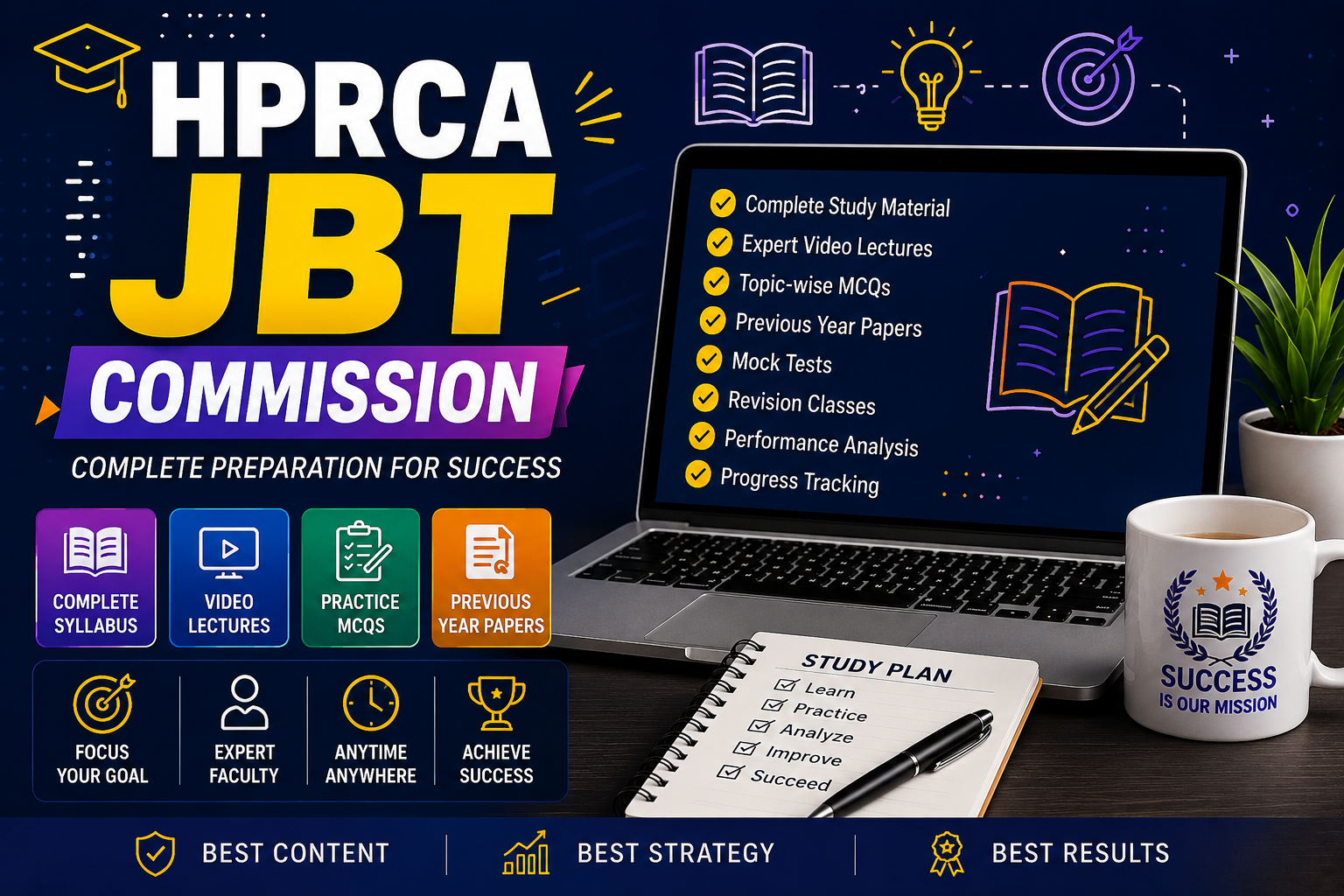
Prepare systematically for the HPRCA JBT Recruitment Examination with our complete syllabus-based course designed according to the prescribed examination pattern. This course covers all important subjects and topics required for the JBT examination, with a clear and structured learning approach.
The course includes Social Science, History, Geography, Economics, Political Science, Mathematics, Science, English, Hindi, General Awareness, Current Affairs, Everyday Science, Logical Reasoning and Computer/Information Technology as applicable to the prescribed syllabus.
What You Will Get
- ✅ Complete HPRCA JBT Syllabus Coverage
- 📚 Subject-wise & Topic-wise Study Material
- 🎯 Syllabus-focused Lessons
- 📝 Topic-wise Practice Questions
- 📖 Previous Year Question Practice
- 🧠 General Awareness & Current Affairs Preparation
- 💻 Computer & Information Technology Topics
- 🔄 Revision-focused Preparation
- 📊 Exam-oriented Learning Approach
Start your HPRCA JBT preparation with a structured, syllabus-focused course and cover every important topic required for the examination.
Course Content
🏛️ TOPIC -1 ANCIENT INDIAN HISTORY
This topic covers the development of early human societies in India, prehistoric cultures, the use and development of stone tools, the Palaeolithic, Mesolithic and Neolithic Ages, Copper, Bronze and Iron Ages, the Indus Valley Civilization, Pre-Vedic and Vedic Culture, major religious movements, the Mauryan Empire, the Shakas, Kushanas and Satavahanas, the Sangam Age and the Cholas, Pandyas and Cheras, followed by the Gupta and Post-Gupta periods including the reign of Harshavardhana. The lessons focus on important historical developments, features, achievements and exam-relevant facts.
-
LESSON 01 — Earliest Societies & Prehistoric India
-
LESSON 02 — Palaeolithic, Mesolithic & Neolithic Ages
-
LESSON 03 — Copper, Bronze & Iron Ages
-
LESSON 04 — Indus Valley Civilization: Sites & Urban Planning
-
LESSON 05 — Indus Valley Civilization: Economy, Art & Society
-
LESSON 06 — Pre-Vedic & Vedic Culture
-
LESSON 07 — Religious Movements & Mauryan Empire
-
LESSON 08 — Shakas, Kushanas & Satavahanas
-
LESSON 09 — Sangam Age: Cholas, Pandyas & Cheras
-
LESSON 10 — Gupta Age & Post-Gupta Age: Harshavardhana
-
FULL VIDEO
🏰 TOPIC-2 MEDIEVAL INDIAN HISTORY
This topic covers the major political, administrative, religious and cultural developments of Medieval India. It begins with the Turkish invasions of India, followed by the establishment and development of the Delhi Sultanate under the Mamluk, Khilji, Tughlaq, Sayyad and Lodi dynasties. It also covers the Sufi and Bhakti movements and their major saints, followed by the Mughal Empire, Maratha Empire and the rise of the Sikh Empire. The lessons focus on important rulers, events, movements, contributions and exam-relevant facts.
-
LESSON 01 — Turkish Invasions in India
-
LESSON 02 — Delhi Sultanate: Mamluk (Slave) Dynasty
-
LESSON 03 — Khilji Dynasty
-
LESSON 04 — Tughlaq, Sayyad & Lodi Dynasties
-
LESSON 05 — Sufi Movement & Chishti Order
-
LESSON 06 — Bhakti Movement: Major Saints & Thinkers
-
LESSON 07 — Mughal Empire: Establishment & Expansion
-
LESSON 08 — Maratha Empire
-
LESSON 09 — Rise of Sikh Empire
-
FULL VIDEO
TOPIC -3 MODERN INDIAN HISTORY
This topic covers the major political, economic and social developments of Modern India, beginning with the arrival of European trading companies and the establishment of British rule. It includes the Governor-Generals of Bengal, Viceroys of India, British economic policies and land settlements, the Revolt of 1857, Social and Religious Reform Movements, the Indian National Movement, major Gandhian movements, revolutionary activities, events leading to independence and the constitutional development of India from the Regulating Act of 1773 to the Indian Independence Act of 1947.
-
LESSON 01 — Arrival of Europeans & Establishment of British Power
-
LESSON 02 — Governor-Generals of Bengal & Viceroys of India
-
LESSON 03 — British Economic Impact & Land Settlements
-
LESSON 04 — Revolt of 1857
-
LESSON 05 — Social & Religious Reform Movements
-
LESSON 06 — Rise of Nationalism & Indian National Congress
-
LESSON 07 — Gandhian Era: Early Movements & Mass Movements
-
LESSON 08 — Civil Disobedience & Constitutional Negotiations
-
LESSON 09 — Revolutionary Nationalism & Road to Independence
-
LESSON 10 — Constitutional Development: 1773–1909
-
LESSON 11 — Constitutional Development: 1935–1947 & Independence
-
FULL VIDEO
🌍 TOPIC – 4 EUROPEAN HISTORY
This topic covers the major political, social, economic and international developments in modern European history. It includes the French Revolution, Industrial Revolution, Unification of Germany and Italy, First World War, League of Nations, Russian Revolution and Socialism, Fascism in Italy, Nazism in Germany, Second World War, and the establishment of the United Nations Organization. The lessons focus on major causes, events, developments, consequences and important exam-oriented facts.
-
LESSON 01 — French Revolution
-
LESSON 02 — Industrial Revolution
-
LESSON 03 — Unification of Germany
-
LESSON 04 — Unification of Italy
-
LESSON 05 — First World War
-
LESSON 06 — League of Nations
-
LESSON 07 — Russian Revolution & Socialism
-
LESSON 08 — Fascism in Italy & Nazism in Germany
-
LESSON 09 — Second World War
-
LESSON 10 — United Nations Organization
-
FULL VIDEO
🌍 TOPIC — 5 GEOGRAPHY
This topic covers the geography of India, physical environment, natural resources, agriculture, population, industries, transport and communication, along with basic concepts of Universe, Solar System, Lithosphere, Rocks, Volcanoes, Earthquakes and Landforms. It includes India's size and location, neighbouring countries, physiographic divisions, drainage systems, climate and monsoon, natural vegetation, wildlife, population distribution and growth, resources and development, farming, minerals, energy, industries, multipurpose river projects, land use and conservation. The lessons are structured to cover the complete syllabus in an exam-oriented manner.
-
LESSON 01 — India: Size, Location & Neighbours
-
LESSON 02 — Physical Features of India
-
LESSON 03 — Drainage System of India
-
LESSON 04 — Climate of India & Monsoon
-
LESSON 05 — Natural Vegetation & Wildlife
-
LESSON 06 — Population of India
-
LESSON 07 — Resources & Development
-
LESSON 08 — Agriculture & Farming in India
-
LESSON 09 — Minerals & Energy Resources
-
LESSON 10 — Manufacturing Industries
-
LESSON 11 — Lifelines of National Economy
-
LESSON 12 — Multipurpose River Projects & Water Conservation
-
LESSON 13 — Universe & Solar System
-
LESSON 14 — Lithosphere, Rocks & Major Landforms
-
LESSON 15 — Volcanoes & Earthquakes
-
FULL VIDEO
💰 TOPIC — 6 ECONOMICS
This topic covers the fundamental concepts of economic development, sectors of the Indian economy, money and credit, globalization, consumer rights, food security and poverty. It explains how development is measured, how different sectors contribute to the economy, the role of banks and credit, the impact of globalization on India, and major economic challenges faced by people and the country. The lessons are designed to cover the complete syllabus in an exam-oriented manner.
-
LESSON 01 — Development
-
LESSON 02 — Sectors of the Indian Economy
-
LESSON 03 — Money and Credit
-
LESSON 04 — Self-Help Groups & Access to Credit
-
LESSON 05 — Globalization & Indian Economy
-
LESSON 06 — Consumer Rights
-
LESSON 07 — Food Security in India
-
LESSON 08 — Poverty & Challenges of Economic Development
-
FULL VIDEO
🏛️ TOPIC — 7 POLITICAL SCIENCE
This topic covers the fundamental concepts of Democracy, the Indian Constitution, Electoral Politics, Political Institutions, Democratic Rights, Federalism, Political Parties, Social Divisions and the functioning of Indian democracy. It includes the Constitution, Fundamental Rights and Duties, Directive Principles, Parliament, President, Prime Minister, Judiciary, State Government, Local Self-Government, Constitutional and statutory institutions, major constitutional amendments, power sharing, federalism, gender, religion, caste and outcomes of democracy. The lessons cover all the given syllabus points in an exam-oriented manner.
-
LESSON 01 — Democracy: Meaning, Features & Importance
-
LESSON 02 — Constitutional Design & Indian Constitution
-
LESSON 03 — Fundamental Rights, Duties & Directive Principles
-
LESSON 04 — Electoral Politics & Election System
-
LESSON 05 — Parliament & Political Executive
-
LESSON 06 — President & Vice-President of India
-
LESSON 07 — Judiciary & Judicial System
-
LESSON 08 — State Government: Legislature & Executive
-
LESSON 09 — Citizenship, Centre-State Relations & Emergency
-
LESSON 10 — Local Self-Government & Decentralization
-
LESSON 11 — Constitutional & Important Institutions
-
LESSON 12 — Political Parties & Anti-Defection Law
-
LESSON 13 — Power Sharing: Belgium & Sri Lanka
-
LESSON 14 — Federalism & Decentralization in India
-
LESSON 15 — Gender, Religion, Caste & Social Divisions
-
LESSON 16 — Planned Economy & Social Movements
-
LESSON 17 — Outcomes of Democracy
-
FULL VIDEO
🔢 TOPIC —8 MATHEMATICS
This topic covers the complete Mathematics syllabus from Number Systems, Arithmetic and Algebra to Geometry, Mensuration, Coordinate Geometry, Trigonometry, Statistics, Probability, Time & Work and Time & Distance. It includes important concepts, formulas, properties, theorems, numerical applications and exam-oriented problem solving. The lessons are arranged so that all the topics given in the syllabus are covered without adding unrelated content.
-
LESSON 01 — Number Systems & Number Operations
-
LESSON 02 — HCF, LCM, Fractions, Decimals & Percentages
-
LESSON 03 — Real Numbers, Exponents, Squares & Cubes
-
LESSON 04 — Ratio, Proportion & Variation
-
LESSON 05 — Algebraic Expressions, Identities & Factorization
-
LESSON 06 — Polynomials
-
LESSON 07 — Linear Equations & Pair of Linear Equations
-
LESSON 08 — Quadratic Equations
-
LESSON 09 — Arithmetic Progression (AP)
-
LESSON 10 — Points, Lines, Angles & Euclidean Geometry
-
LESSON 11 — Triangles: Properties, Congruence & Similarity
-
LESSON 12 — Quadrilaterals & Polygons
-
LESSON 13 — Circles
-
LESSON 14 — Geometrical Constructions
-
LESSON 15 — Mensuration: Areas & Perimeters
-
LESSON 16 — Surface Areas & Volumes
-
LESSON 17 — Coordinate Geometry
-
LESSON 18 — Introduction to Trigonometry
-
LESSON 19 — Applications of Trigonometry: Heights & Distances
-
LESSON 20 — Statistics & Data Handling
-
LESSON 21 — Probability
-
LESSON 22 — Time & Work
-
LESSON 23 — Time, Speed & Distance
-
FULL VIDEO
🔬 TOPIC — 9 SCIENCE
This topic covers the complete Science syllabus from basic food, materials, plants, animals, motion and measurement to Physics, Chemistry, Biology, Environment and Human Health. It includes nutrition, microorganisms, matter, chemical reactions, force, motion, electricity, magnetism, light, sound, reproduction, life processes, heredity, environment and natural resources. The lessons are arranged to cover all syllabus points without adding unrelated topics, with an exam-oriented focus.
-
LESSON 01 — Components of Food & Balanced Diet
-
LESSON 02 — Sorting Materials & Separation of Substances
-
LESSON 03 — Plants & Their Parts
-
LESSON 04 — Body Movements & Animal Movement
-
LESSON 05 — Living Organisms, Characteristics & Habitats
-
LESSON 06 — Motion & Measurement of Distance
-
LESSON 07 — Light, Shadows & Reflections
-
LESSON 08 — Electricity, Circuits & Magnets
-
LESSON 09 — Air Around Us & Nutrition in Plants
-
LESSON 10 — Nutrition in Animals
-
LESSON 10 — Nutrition in Animals
-
LESSON 11 — Heat
-
LESSON 12 — Acids, Bases & Salts
-
LESSON 13 — Physical & Chemical Changes
-
LESSON 14 — Respiration in Organisms
-
LESSON 15 — Reproduction in Plants & Seed Dispersal
-
LESSON 16 — Motion & Time
-
LESSON 17 — Electric Current & Its Effects
-
LESSON 18 — Light: Reflection, Mirrors & Lenses
-
LESSON 19 — Forests, Water & Wastewater Management
-
LESSON 20 — Crop Production & Management
-
LESSON 21 — Microorganisms: Friend & Foe
-
LESSON 22 — Coal, Petroleum & Natural Resources
-
LESSON 23 — Combustion & Flame
-
LESSON 24 — Conservation of Plants & Animals
-
LESSON 25 — Reproduction in Animals
-
LESSON 26 — Adolescence & Reproductive Health
-
LESSON 27 — Force & Pressure
-
LESSON 28 — Friction
-
LESSON 29 — Sound
-
LESSON 30 — Chemical Effects of Electric Current
-
LESSON 31 — Natural Phenomena: Lightning & Earthquakes
-
LESSON 32 — Light, Human Eye & Optical Phenomena
-
LESSON 33 — Matter, Elements, Compounds & Mixtures
-
LESSON 34 — Atoms, Molecules & Structure of Atom
-
LESSON 35 — Cell & Tissues
-
LESSON 36 — Improvement in Food Resources
-
LESSON 37 — Motion, Force & Laws of Motion
-
LESSON 38 — Gravitation, Work & Energy
-
LESSON 39 — Sound: Production, Propagation & Reflection
-
LESSON 40 — Chemical Reactions & Equations
-
LESSON 41 — Acids, Bases, Salts, Metals & Non-Metals
-
LESSON 42 — Carbon & Its Compounds
-
LESSON 43 — Life Processes
-
LESSON 44 — Control & Coordination
-
LESSON 45 — Reproduction, Heredity & Evolution
-
LESSON 46 — Light: Reflection & Refraction
-
LESSON 47 — Human Eye & Colourful World
-
LESSON 48 — Electricity
-
LESSON 49 — Magnetic Effects of Electric Current
-
LESSON 50 — Our Environment
-
FULL VIDEO
TOPIC – 10 ENGLISH
This English section covers Reading Comprehension, Vocabulary and essential English Grammar required for the examination. Students will learn sentence structure, parts of speech, articles, nouns, pronouns, verbs, tenses, subject-verb agreement, voice, narration, phrases, clauses, sentence transformation, error correction, sentence rearrangement, synonyms, antonyms, idioms and one-word substitutions. The lessons are designed to strengthen grammatical accuracy, vocabulary and reading ability through exam-oriented concepts and practice.
-
Lesson 01 — Reading Comprehension & Word Power
-
Lesson 02 — Sentence & Basic Grammar
-
Lesson 03 — Parts of Speech & Verb Forms
-
Lesson 04 — Tenses & Subject-Verb Agreement
-
Lesson 05 — Active & Passive Voice
-
Lesson 06 — Direct & Indirect Speech
-
Lesson 07 — Phrases, Clauses & Sentence Transformation
-
Lesson 08 — Error Correction & Sentence Rearrangement
-
FULL VIDEO
TOPIC – 12 हिंदी
इस विषय में हिंदी भाषा, व्याकरण एवं लिपि से संबंधित सभी महत्वपूर्ण पाठ्यक्रम बिंदुओं को शामिल किया गया है। इसमें हिंदी भाषा एवं व्याकरण का परिचय, वर्ण-विचार, शब्द-विचार, शब्दों के विभिन्न प्रकार, रचना एवं प्रयोग के आधार पर शब्द, संज्ञा, सर्वनाम, क्रिया, विशेषण, क्रिया-विशेषण, संबंधबोधक, समुच्चयबोधक, विस्मयादिबोधक, पद परिचय, शब्द-शक्तियाँ, शब्द रूपांतरण, लिंग, वचन, कारक, काल, वाक्य, संधि, समास, उपसर्ग, प्रत्यय, पर्यायवाची, विलोम, वाक्यांश के लिए एक शब्द, समानार्थी शब्द, विराम चिह्न, शब्द एवं वाक्य शुद्धि, मुहावरे, लोकोक्तियाँ तथा अलंकार शामिल हैं।
-
Lesson 01 — हिंदी भाषा, व्याकरण एवं लिपि
-
Lesson 02 — शब्द-विचार एवं शब्दों का वर्गीकरण
-
Lesson 03 — विकारी एवं अविकारी शब्द
-
Lesson 04 — शब्द-शक्तियाँ एवं शब्द रूपांतरण
-
Lesson 05 — संधि, समास, उपसर्ग एवं प्रत्यय
-
Lesson 06 — वाक्य-विचार एवं अर्थ-विचार
-
Lesson 07 — विराम चिह्न एवं शुद्धिकरण
-
Lesson 08 — मुहावरे, लोकोक्तियाँ एवं अलंकार
-
FULL VIDEO
TOPIC -13 GENERAL AWARENESS
This section covers the complete General Awareness syllabus required for the examination. It includes General Knowledge with special emphasis on Himachal Pradesh General Knowledge, Current Affairs, Everyday Science, Logical Reasoning, Hindi at Matric standard, and English at Matric standard. The lessons focus on important concepts, facts, reasoning skills, language ability and exam-oriented preparation.
-
Lesson 01 — General Knowledge & Himachal Pradesh General Knowledge
-
Lesson 02 — Current Affairs
-
Lesson 03 — Everyday Science
-
Lesson 04 — Logical Reasoning
-
Lesson 05 — Hindi (Matric Standard)
-
Lesson 06 — English (Matric Standard)
-
FULL VIDEO
TOPIC 14 — Understanding the Psychology of Children
This topic develops an understanding of children's psychological development and its importance in education. It covers psychological perspectives, growth and development, family and adult-child relationships, humanistic psychology, developmental theories, intelligence, creativity, personality, learning, memory, forgetting, guidance and counselling
-
Lesson 01 — Perspectives of Psychology in Education
-
Lesson 02 — Growth, Development and Family Relationships
-
Lesson 03 — Humanistic Psychology and Developmental Theory
-
Lesson 04 — Intelligence, Creativity and Personality
-
Lesson 05 — Learning, Memory and Forgetting
-
Lesson 06 — Guidance and Counselling
-
FULL VIDEO
TOPIC 15 — Education in Contemporary Indian Society
This topic examines education in the context of contemporary Indian society. It covers India's emergence from the freedom struggle, the Constitution and education, democracy in India and the Indian economy.
-
Lesson 01 — India and the Emergence from the Freedom Struggle
-
Lesson 02 — Constitution of India and Education
-
Lesson 03 — Democracy in India and Education
-
Lesson 04 — Indian Economy and Education
-
FULL VIDEO
TOPIC 16 — Education, Society and Curriculum
This topic explains education through philosophical and sociological perspectives. It covers education for peace, human rights, child rights, knowledge and curriculum.
-
Lesson 01 — Philosophical Understanding of Education
-
Lesson 02 — Sociological Bases of Education
-
Lesson 03 — Education for Peace, Human Rights and Child Rights
-
Lesson 04 — Knowledge and Curriculum
-
FULL VIDEO
TOPIC 17 — Pedagogy Across the Curriculum
This topic focuses on effective teaching and learning across different areas of the curriculum. It covers methods of inquiry, ICT, pedagogic practices, learning processes and teaching proficiency.
-
Lesson 01 — Knowledge and Methods of Inquiry
-
Lesson 02 — ICT and Developing Capacities
-
Lesson 03 — Pedagogic Practice and the Process of Learning
-
Lesson 04 — Teaching Proficiency
-
FULL VIDEO
TOPIC 18 — Teaching of the English Language
This topic focuses on teaching English at the elementary level. It covers the nature of English, language skills, lesson planning, assessment, teaching approaches, teaching issues and teaching resources.
-
Lesson 01 — Nature of English Language and Language Skills
-
Lesson 02 — Teaching Listening, Speaking, Reading and Writing
-
Lesson 03 — Lesson Planning and Learner Assessment
-
Lesson 04 — Issues and Approaches in Teaching English
-
Lesson 05 — Planning and Resources for Teaching English
-
FULL VIDEO
TOPIC 19– हिन्दी भाषा शिक्षण
यह विषय प्राथमिक स्तर पर हिन्दी भाषा के प्रभावी शिक्षण से संबंधित है। इसमें भाषा की प्रकृति, भाषा कौशल, हिन्दी शिक्षण में अधिगम संसाधनों का उपयोग, पाठ योजना निर्माण, भाषा में मापन एवं मूल्यांकन, चिंतन-कौशल, समसामयिक संदर्भों में हिन्दी भाषा, पाठ्यक्रम एवं भाषा शिक्षण तथा विद्यार्थियों के सीखने का मूल्यांकन शामिल है।
-
Lesson 1 हिन्दी भाषा एवं भाषा शिक्षण का परिचय
-
Lesson 2 भाषा कौशल एवं अधिगम संसाधन
-
Lesson 3 भाषा शिक्षण एवं पाठ योजना
-
Lesson 4 भाषा में मापन एवं मूल्यांकन
-
Lesson 5 चिंतन-कौशल एवं हिन्दी भाषा की समसामयिकता
-
Lesson 6 पाठ्यक्रम एवं हिन्दी भाषा शिक्षण
-
Lesson 7 हिन्दी भाषा में मूल्यांकन एवं मापन
-
FULL VIDEO
TOPIC 20 — Teaching of Mathematics
This topic focuses on the pedagogy of mathematics and covers mathematical knowledge, pedagogical content knowledge, teaching approaches, assessment, mathematical reasoning, algebraic thinking, geometry, mathematical communication and evaluation.
-
Lesson 01 — Mathematical Knowledge and Pedagogical Content Knowledge
-
Lesson 02 — Aspects of Teaching Mathematics and Assessment
-
Lesson 03 — Mathematical Reasoning and Algebraic Thinking
-
Lesson 04 — Geometry: Space and Shapes
-
Lesson 05 — Communicating Mathematics and Evaluation
-
FULL VIDEO
TOPIC 21 — Teaching of Environmental Studies
This topic focuses on the teaching of Environmental Studies at the elementary level. It covers the concept of EVS, children's ideas, planning, classroom transaction and assessment.
-
Lesson 01 — Concept of Environmental Studies
-
Lesson 02 — Understanding Children’s Ideas in EVS
-
Lesson 03 — Planning and Classroom Transaction
-
Lesson 04 — Assessment in Environmental Studies
-
FULL VIDEO
TOPIC 22 — Children’s Physical and Emotional Health, School Health and Education
This topic focuses on children's physical and emotional well-being and school health. It covers health needs, physical education, health education, diseases, emotional health, diversity, inclusion, lifestyle and stress management.
-
Lesson 01 — Health and Well-Being of Children
-
Lesson 02 — Children’s Health in the School Context
-
Lesson 03 — Physical Education and Health Education
-
Lesson 04 — Communicable and Non-Communicable Diseases
-
Lesson 05 — Emotional Health, Diversity and Inclusion
-
Lesson 06 — Contemporary Lifestyle and Stress Management
-
FULL VIDEO
TOPIC 23 — Creative Drama, Fine Arts and Education
This topic explains the importance of arts in education. It covers art education, visual arts, crafts, performing arts, planning and organization of art experiences and evaluation of art-integrated learning.
-
Lesson 01 — Understanding Art and Art Education
-
Lesson 02 — Visual Arts and Crafts
-
Lesson 03 — Performing Arts and Creative Drama
-
Lesson 04 — Planning and Organization of Art Experiences
-
Lesson 05 — Evaluation in Art Education and Art-Integrated Learning
-
FULL VIDEO
TOPIC 24 — Work Education
This topic focuses on the concept, importance and practical implementation of work education. It covers work education activities, community involvement, organization, management and evaluation.
-
Lesson 01 — Concept and Importance of Work Education
-
Lesson 02 — Work Education Activities and Community
-
Lesson 03 — Organization and Management of Work Education
-
Lesson 04 — Evaluation in Work Education
-
FULL VIDEO
TOPIC 25 — Teacher Identity, School Culture and Leadership
This topic focuses on the professional identity of teachers, school culture and educational leadership. It covers educational vision, research skills, leadership, school organization, management and change facilitation.
-
Lesson 01 — Teacher Identity and Vision of Education
-
Lesson 02 — Research Skills and Educational Leadership
-
Lesson 03 — School Organization and Management
-
Lesson 04 — Change Facilitation in Education
-
FULL VIDEO
TOPIC 26 — Diversity, Gender and Inclusive Education
This topic develops an understanding of diversity and inclusion in education. It covers inclusive education, children with special needs, exclusion, inclusion, gender, school and society.
-
Lesson 01 — Inclusive Education
-
Lesson 02 — Children with Special Needs
-
Lesson 03 — Overcoming Exclusion and Promoting Inclusion
-
Lesson 04 — Gender, School and Society
-
FULL VIDEO
TOPIC 27 — Science Education
This topic focuses on the teaching and learning of science. It covers understanding science and children's ideas, learning resources, organization and management, classroom transaction and evaluation.
-
Lesson 01 — Understanding Science and Children’s Ideas
-
Lesson 02 — Learning Resources in Science Education
-
Lesson 03 — Organization, Management and Classroom Transaction
-
Lesson 04 — Evaluation in Science Education
-
FULL VIDEO
TOPIC 28 — Social Science Education
This topic focuses on the teaching of Social Sciences at the elementary level. It covers the nature and important concepts of Social Sciences, children's understanding, teaching-learning materials, lesson planning, pedagogy and assessment.
-
Lesson 01 — Nature of Social Sciences
-
Lesson 02 — Important Concepts of Social Sciences
-
Lesson 03 — Children’s Understanding and Teaching-Learning Materials
-
Lesson 04 — Lesson Planning and Pedagogy of Social Science
-
Lesson 05 — Assessment in Social Science Education
-
FULL VIDEO
Student Ratings & Reviews

No Review Yet